
Beginner's Guide: How to Make the Perfect Cup of Gongfu Tea
Gongfu tea is not complicated to start. The core idea is simple: use more leaf, less water, and shorter steeps than you are used to. What you get in return is a session of 8-15 infusions, each tasting slightly different from the last.
This guide walks you through the process from the first step to the final cup.
Step 1: Choose Your Tea
Any loose-leaf tea works with Gongfu technique, but oolong and puerh are the most forgiving for beginners. Oolongs like Tie Guan Yin or Da Hong Pao are aromatic and reveal clear changes across infusions. Ripe puerh is smooth and low in bitterness, which makes it easy to practice with. Green tea works too, but requires more precise temperature control, so it is worth attempting once you have a feel for the process.
Step 2: Gather Your Equipment
You need three things to start:
Teapot or gaiwan. A gaiwan is the better beginner choice. It works with any tea, is easy to clean, and gives you full control over the pour. A 100-150ml size is practical for one or two people.
Fairness pitcher (Gong Dao Bei). You decant the finished infusion here before pouring into cups. This stops extraction at the right moment and ensures every cup is the same strength.
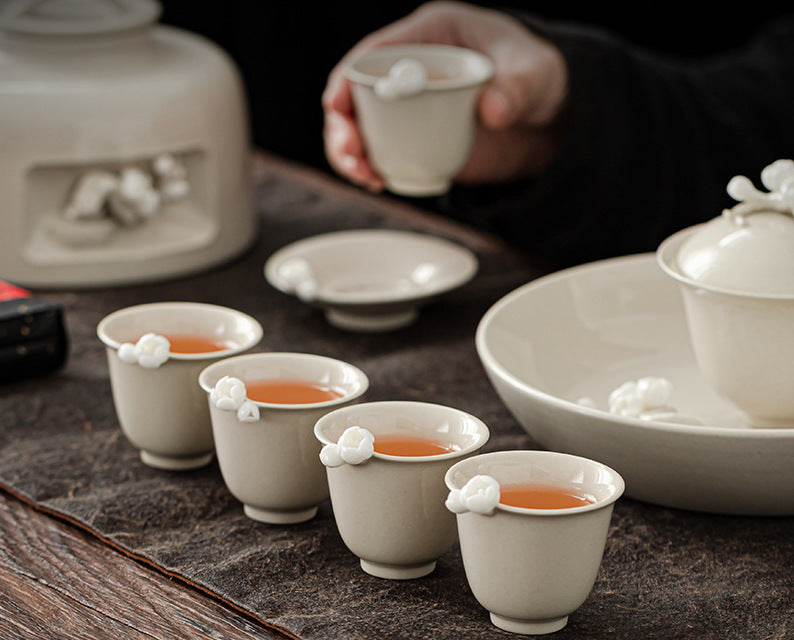
Small cups. 30-60ml is standard. Small cups mean you finish each infusion in a few sips while it is still at the right temperature.
Supporting tools worth having: a tea tray to catch spills, a strainer for stray leaves, and a tea pick if you are brewing compressed puerh cakes. The Oriental Creations carries all of these individually or as complete Gongfu sets if you want to start with everything in one go.
Step 3: Measure Your Leaves
Use roughly 1g of tea per 15ml of water as a starting point. For a 100ml gaiwan that is about 6-7g. This is a much higher ratio than Western brewing, which is why steeping times are kept very short.
Step 4: Warm Your Vessels
Pour hot water into your gaiwan, fairness pitcher, and cups. Swirl and discard. This prevents your small vessels from dropping the water temperature the moment tea goes in, which matters because Gongfu brewing volumes are tiny.
Step 5: Rinse the Leaves
Add your measured leaves to the warmed gaiwan. Pour hot water over them and immediately drain. Do not steep. This rinse opens the leaves and removes any dust from processing. Discard this water.
Step 6: Brew and Decant
Pour hot water over the leaves and steep according to your tea type:
Oolong (strip-style, e.g. Da Hong Pao): 95°C, start at 20 seconds, add 5 seconds each round.
Oolong (ball-rolled, e.g. Tie Guan Yin): 95°C, start at 30-40 seconds to allow the leaves to open, then reduce to 10-15 seconds from the second infusion onward.
Ripe puerh: 99°C, start at 10-15 seconds, add 5 seconds each round.
White tea: 85°C, start at 10 seconds, add 10 seconds each round.
Green tea: 80°C, start at 10 seconds, keep infusions short throughout.
When the time is up, decant fully into the fairness pitcher, then pour into cups. Do not leave liquid in the gaiwan or it will keep extracting.
Step 7: Taste and Adjust
After the first infusion, assess the tea. Too bitter means shorten the steep or lower the temperature. Too thin means add a few seconds. Gongfu Cha rewards small adjustments, so take notes if something works well.
Step 8: Keep Going
A good oolong or puerh changes noticeably across infusions. Some teas peak as early as the second or third round. Others build gradually and hold their best flavors through the middle infusions before softening toward the end. The session ends when the flavor fades, not after a fixed number of cups.
When you are finished, rinse all vessels with hot water and let them air dry. Avoid soap on unglazed clay teapots.
Gongfu tea is a skill that improves quickly with practice. Start with a simple gaiwan, one tea you enjoy, and the parameters above. Everything else follows from there.